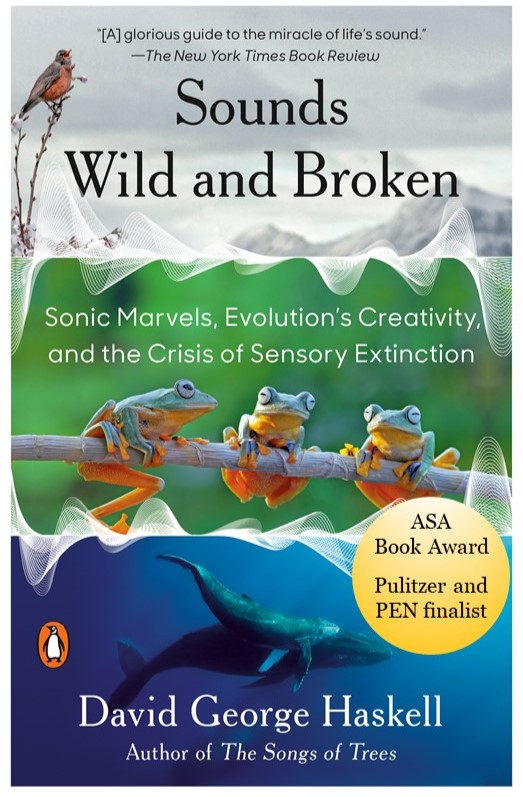
Sounds Wild and Broken: Sonic Marvels, Evolution’s Creativity, and The Crisis Of Sensory Extinction.
Finalist, 2023 Pulitzer Prize, General Nonfiction
Finalist, 2023 PEN/E. O. Wilson Literary Science Writing Award
Winner, Acoustical Society of America’s 2023 Science Communication Award (Long-form Print category)
Editor’s Choice, The New York Times Book Review
Book of the Day, The Guardian
Now out in paperback at your favorite indie bookstore or online: (United States, United Kingdom, Australia; translations in Chinese (complex characters), French, Italian, Japanese, and Korean).
“‘Sounds Wild and Broken’ affirms Haskell as a laureate for the earth … a glorious guide to the miracle of life’s sound” Cynthia Barnett reviewing in The New York Times Book Review.
“Haskell serves as an irresistible guide in this nuanced and meditative paean” The New York Times Book Review, “New Paperback” recommendations.
“captivating…The science stories in Sounds Wild and Broken offer one delight after another.” Kathleen Dean Moore in Scientific American.
“This is how scientific writing should be, and almost never is: suffused with wonder and pathos, throbbing with the music of the wild. Haskell conducts a magnificent symphony here. He shows us – no, lets us hear – that we are resonant animals in a thrillingly resonant universe, and that our fulfilment depends on finding the frequency that will make us resonate with everything else. His superb book sent me on my way singing, and trying to join in with the songs I heard on the way.” Charles Foster, author of Being a Beast and Being a Human
“It’s beautiful, Haskell’s devotion to his ears. As a working music critic for 15 years and counting, I find myself moved by his belief that listening to the voices of others might inspire us to empathy.” Jayson Greene in Los Angles Review of Books.
“Few nature writers reveal ecological connections with the daring, elegance and authority of David George Haskell … repeatedly surprises and challenges us by the connections he makes” Paddy Woodworth in The Irish Times.
“meditative and celebratory” Caspar Henderson in The Spectator.
“A joyous celebration of the music of life… Sparkling prose conveys an urgent message.” Starred review, Kirkus Reviews.
Join me in a 40-minute narrated sonic journey When the Earth Started to Sing with Emergence Magazine. Winner of both the Gold and the Listener’s Choice Award in the Signal Awards for three categories: “Most Innovative Audio Experience,” “Best Editing,” and “Best Sound Design”.
I’ll send you a bookplate. Request one here.
Explore sound clips from the book.
“something of an idiosyncratic genius … if anyone could make me or anyone else care about the precarious fate of sound on earth, it was him” Paul Kvinta in Outside Magazine
“Sounds Wild and Broken is a symphony, filled with the music of life. It is fascinating, heartbreaking, and beautifully written.” Elizabeth Kolbert, author of Under a White Sky: The Nature of the Future
“Whether describing the human brain or the ways different conifer forests change the voices and crooked beaks of red crossbills…Haskell speaks a celebratory poetry of nature” Michael Ray Taylor reviewing in Chapter 16.
“With persistent intelligence and understated wit, Haskell uncovers one subtle mystery after another, forming a gorgeous argument for protecting all we long to hear.” Colleen Mondor for Booklist
“Listen to David Haskell: He will transform the way you hear the world. Haskell is one of those rare scientists who illuminates his topic—the magnificent natural sonic diversity of our planet, what we have to gain from its richness, what we have to lose from its diminishment—in lyrical, erudite prose that both informs and inspires. This masterful book is a gift of deep aural understanding and a resplendent read.” Jennifer Ackerman, author of The Genius of Birds and The Bird Way
“A stunning call to reinhabit our ancient communion with sound. David George Haskell’s gorgeous prose and deep research meld wonder with intellect, inspiring reverence, delight, and a sense of urgency in protecting aural diversity. The voice of the earth is singing with beauty and need—Haskell shows us the extraordinary gift and responsibility of being available to listen.” Lyanda Lynn Haupt, author of Rooted: Life at the Crossroads of Science, Nature, and Spirit, and Mozart’s Starling
“This is how scientific writing should be, and almost never is: suffused with wonder and pathos, throbbing with the music of the wild. Haskell conducts a magnificent symphony here. He shows us – no, lets us hear – that we are resonant animals in a thrillingly resonant universe, and that our fulfilment depends on finding the frequency that will make us resonate with everything else. His superb book sent me on my way singing, and trying to join in with the songs I heard on the way.” Charles Foster, author of Being a Beast and Being a Human
“In Sounds Wild and Broken, David George Haskell once again expands our sensory universe, revealing not only the grand variety of earthly song, music, and speech but the astonishing ways in which sound originates, evolves, and binds us together. His careful listening will sharpen your ears.” Michelle Nijhuis, author of Beloved Beasts: Fighting for Life in an Age of Extinction
“In luminous prose, David Haskell teaches us to hear the beauty and tragedy of the whole history of life on Earth. Sounds Wild and Broken will change the way you listen to nature and to yourself, and may this help us heal our planet before it’s too late.” David Rothenberg, author of Nightingales in Berlin and Why Birds Sing
“This brilliant book—and I don’t use the term lightly—will change the way you hear everything. Haskell takes us deep inside the minds and music of human and non-human life, revealing one marvel after another, and makes a powerful case for conservation that not only preserves species, but the sensory experience of life itself.” Jonathan Meiburg, musician and author of A Most Remarkable Creature
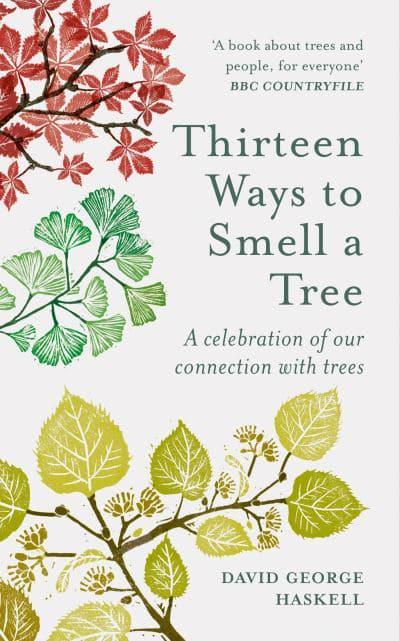
Thirteen Ways to Smell a Tree. October 2021. Now out in paperback. Published in UK; Blackwell’s ships free to US.
Best Books of 2021, Radio Times. “…enchanting, magical insight into the wonder of trees” Kate Humble
“contagious enthusiasm … Haskell’s sustained sniffing is an example of how we can acknowledge, and perhaps begin to appreciate, all that exists outside human agendas and forms of communication.” Kate Simpson in Times Literary Supplement.
“This is a book for literary connoisseurs, fact-lovers and environmentalists. In short, it is a book about trees and people, for everyone.” BBC Countryfile
“Eclectic, brilliant and beautifully written, David Haskell reboots our aromatic memory reminding us of how our lives are intertwined with the wonder of trees. A treat not to be sneezed at.” Sir Peter Crane, FRS.
“Thirteen Ways to Smell a Tree is a transportive olfactory journey through the forest that sets the sense tingling. Every chapter summons a new aroma: leaf litter and woodsmoke, pine resin and tannin, quinine and bay leaf—life in all its glorious complexity. David George Haskell is a knowledgeable, witty and erudite companion, who takes us by the hand and leads us through the world, reminding us to breathe it all in. This book is a breath of fresh air.” Cal Flyn, author of Islands of Abandonment.
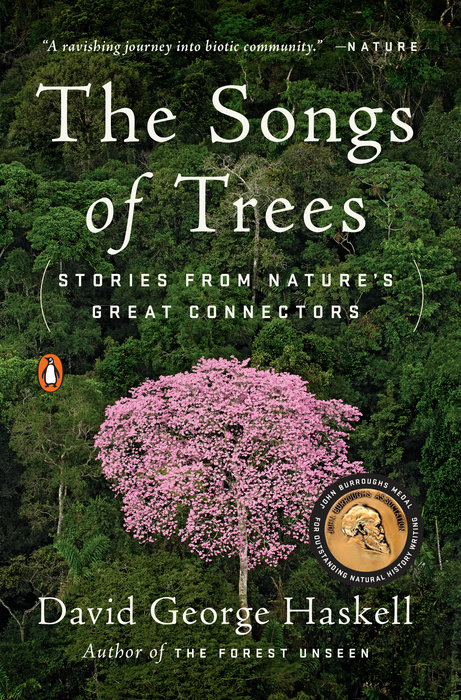 The Songs of Trees:
Winner of the 2020 Iris Book Award
Winner of the 2018 John Burroughs Medal
Best Science Books of 2017, NPR Science Friday
Favorite Science Books of 2017, Brain Pickings
The 10 Best Environment, Climate Science and Conservation Books of 2017, Forbes.com
“A work of scientific depth and lyricism” The Guardian
“has the diverse busyness of a thriving woodland. It is hard to think of a recent scientifically-inflected book on nature that is as fluent, compelling, and intoxicatingly rich.” The Times Literary Supplement.
“Haskell proves himself to be the rare kind of scientist Rachel Carson was when long ago she pioneered a new cultural aesthetic of poetic prose about science…a resplendent read in its entirety” Maria Popova in Brain Pickings
Interviews in Outside Magazine and Yale Environment 360.
Listen to a compilation of sounds from the trees or visit with them through photos and sound.
More…
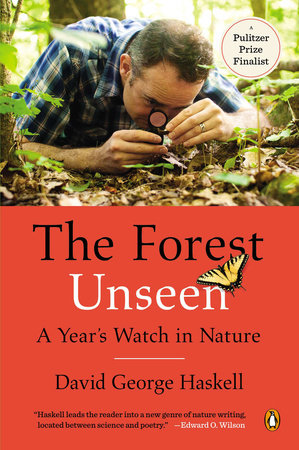 The Forest Unseen:
Winner of 2013 Best Book Award from the National Academies
Finalist for 2013 Pulitzer Prize in General Nonfiction
Runner-up for 2013 PEN/E.O. Wilson Literary Science Writing Award
Winner of the 2013 Reed Environmental Writing Award
Winner of the 2012 National Outdoor Book Award for Natural History Literature
Dapeng Nature Writing Award (in translation). Shenzhen, China. 2016.
“He thinks like a biologist, writes like a poet, and gives the natural world the kind of open-minded attention one expects from a Zen monk rather than a hypothesis-driven scientist.” James Gorman, The New York Times
“…a new genre of nature writing, located between science and poetry.” Edward O. Wilson, Harvard University
More…
Recent essays and collaborations:
Eastern Forest Playing Cards, with artist Ellen Litwiller, from The Art of Play
The voices of birds and the language of belonging. Emergence Magazine. Includes audio essay with bird song.
The Atomic Tree. VR experience based on the last chapter of The Songs of Trees.
Time travel with trees. The New York Times Sunday Review
The seasons aren’t what they used to be. The New York Times
Concurrent-Dyscurrent. CD/digital tracks of 4-minute field recording compositions (also on all streaming services).
More…
 David George Haskell